Bass Translation
How to Make Bass Audible on Small Speakers
You've spent an evening on an 808. On the monitors it's right: the long notes bloom, the slides land, the track sits on top of it. Then you play the bounce on your phone and half the bassline is gone. The hats and vocal are fine, but the low notes that carried the hook have turned into a faint click.
The obvious move is to push 40 or 50 Hz. It rarely helps, because the phone can barely reproduce that region in the first place. This guide explains why bass drops out on small speakers, how hearing fills part of the gap, and how EQ, saturation, layering and bass enhancement each deal with it.
The Problem
Why bass disappears on small speakers
Low frequencies need a lot of air moved, and small speakers are bad at moving air. A tiny driver can only travel so far before it hits its mechanical limit, the space behind it (a few cubic centimetres inside a phone, a thin slot in a laptop) can't support deep extension, and most devices add protective filtering and limiting so the driver doesn't distort when someone turns it up.
How much survives varies a lot. A flagship phone, a budget laptop and a cheap Bluetooth speaker all behave differently, and there's no single frequency where "phone bass" stops. (Earbuds are their own case: with a good seal many reach surprisingly low.) What limited systems share is that deep fundamentals come out heavily reduced, often far enough that they stop contributing much to what you hear.
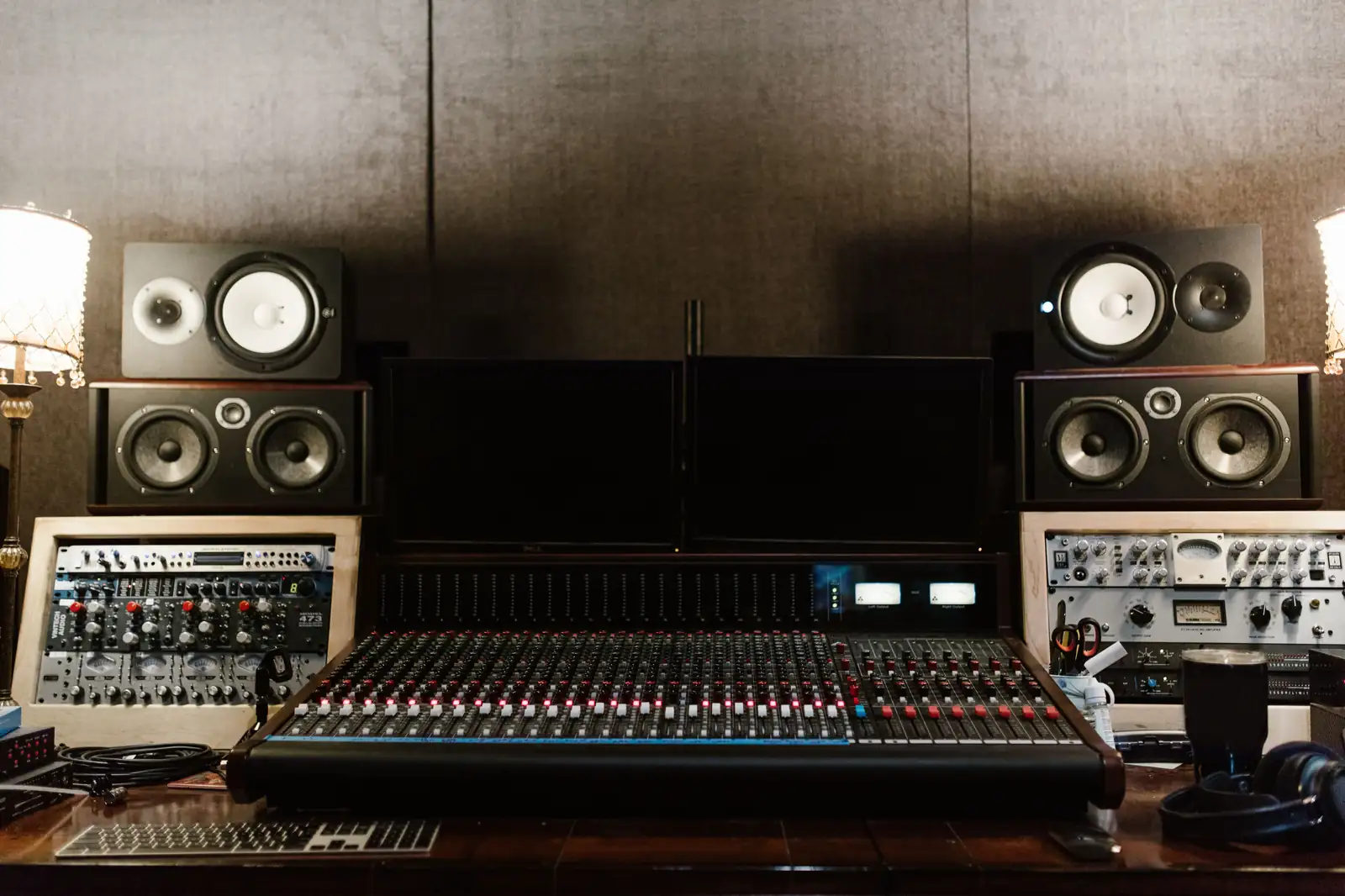
Whether that matters depends on what the sound is made of. Take two bass parts playing the same low note.
The first is a sine-heavy 808. Nearly all of its useful energy sits at the fundamental, plus a short click at the start. When the playback system can't reproduce that fundamental, what you hear is the click and maybe a faint trace of the note.
The second is a bass guitar. Its fundamental is there too, but so is a stack of other information: string harmonics, pickup character, finger or pick noise, and whatever the amp or DI chain adds. Take away the lowest part and there's still plenty higher up. The bass loses weight on a phone, but you can usually still follow the part.
The Psychoacoustics
How harmonics make bass audible when the fundamental disappears
The bass guitar survives because of a well-documented quirk of pitch perception, usually called the missing fundamental.
A pitched note is rarely one frequency. A bass note with a 50 Hz fundamental also carries harmonics at whole-number multiples: 100, 150, 200, 250 Hz and upward, all spaced 50 Hz apart.
Full-range playback
Small-speaker playback
Given a pattern like 100, 150, 200 and 250 Hz, your auditory system tends to hear a pitch matching their common spacing, 50 Hz, even when very little energy is present there. So if a small speaker heavily attenuates the fundamental but reproduces enough of the harmonics, you still hear the low note.
This is perception, not reconstruction. Nothing in the room is moving at 50 Hz; your brain is interpreting a harmonic pattern as belonging to a low pitch. You won't feel it the way you would on a subwoofer, but the musical information (which note, when, for how long) comes through. It works best with several consecutive harmonics. A single isolated partial just sounds like a higher note.
That's why adding upper harmonics helps a bassline on a phone, and adding more deep bass usually doesn't.
Four Ways To Do It
EQ, saturation, layering and bass enhancement
These get recommended in the same breath, but they aren't interchangeable. Some reshape information already in the sound, some create new information, and one tool often lumped in with them solves a different problem entirely.
| What it does | Best when | Limitation | |
|---|---|---|---|
| EQ | Changes the level of frequencies already present | Useful upper harmonic content already exists | Can't create information that isn't there |
| Saturation | Creates additional harmonics through distortion | 808s, synth bass and sounds that can take some grit | Changes the timbre and can congest the low mids |
| Layering | Adds a second layer an octave up or with a richer tone | The production is still editable | Tuning, phase, envelopes and note lengths all need attention |
| Bass enhancement | Generates focused harmonics related to the bass notes | The low end already sounds right but needs to translate | Pushed too far, it crowds the low mids |
| Subharmonics | Creates new content below the source | A full-range system needs more physical depth | Does nothing for a speaker that can't play the original sub |
EQ: bring out what is already there
If a sound already has useful content above the deep bass, EQ is often the simplest and cleanest fix. A bass guitar that goes vague on a laptop might only need a few dB of its body or upper harmonics. Find that region by sweeping and listening rather than following a chart, because it moves with the note range and the arrangement.
The limit is that EQ can only turn up what exists. Boost 200 Hz on a near-pure sine 808 and not much happens, because there's almost nothing at 200 Hz to boost. That doesn't make EQ the weaker option. On a harmonically rich bass guitar it's often the best one, because it changes the character of the sound the least.
Saturation: create new harmonics
Saturation and distortion are nonlinear: the output isn't a scaled copy of the input, so the waveform gets reshaped and new frequencies appear. Drive a 50 Hz sine into a clipper and you get harmonics at multiples of 50 Hz. Symmetrical clipping mostly adds odd harmonics (150, 250, 350 Hz), while asymmetrical curves add even ones as well. Either way the 808 now has something a phone can play.
That's a large part of why distorted 808s translate so well. The catch is that distortion changes the sound. It adds grit and density, and across a whole bass part it can pile energy into the low mids, right where the kick body and the bottom of the keys already live.
Parallel and multiband saturation give you more control. Blend a saturated copy under the clean signal, or keep the lowest band clean and only drive what's above it, or drive a copy and high-pass the result so only the new harmonics come through. The clean fundamental stays as it was, and the harmonics become a separate fader.
Layering: build translation into the sound
If you're still writing the track, you can design translation into the patch: a clean sub, often close to a sine, for the physical low end, and a second layer an octave up or with a brighter tone that carries the note on small systems. Plenty of synth bass presets are already built this way.
It's fiddly, though. The layers have to be tuned to each other, including glides. Their phase relationship changes how the low end sums, so a layer that sounds great solo can thin the sub out. Envelopes need to line up, and note lengths need to match or you'll hear the top layer stop while the sub rings on. That's manageable in your own arrangement. With only a rendered stem, processing it is usually more practical.
Subharmonics: more low end is a different problem
Subharmonic synthesis gets confused with bass enhancement constantly. They work in opposite directions.
A subharmonic generator creates content below the source, typically around an octave down: a kick near 60 Hz gains energy near 30 Hz. On a club rig or a car with a subwoofer, the sound gets physically deeper. Rumble tools like our Seaquake live in similar territory, designing low-end movement under a kick.
Psychoacoustic bass enhancement goes the other way. It generates information above the deep bass, in a range a limited speaker can actually reproduce, so the notes you already have stay perceptible.
So if an 808 vanishes on a phone, a subharmonic generator isn't the fix. The phone couldn't reproduce the original fundamental, and it will do even less with something an octave below it.
In Practice
How to make 808s, bass guitar and kicks translate
The best technique depends heavily on the source. A sine 808 and a picked bass guitar fail on small speakers for different reasons, so they need different first moves.
808s and synth sub
Sine-heavy 808s are one of the clearest translation problems there is, because so much of the sound lives in a region limited speakers barely touch.
- Get the 808 sounding correct on your normal full-range monitoring.
- Check a representative section, ideally with its lowest notes, through a phone, laptop or small speaker.
- Listen for notes, or parts of notes, that disappear. Long low notes often fade after the click while higher ones survive.
- Work out whether enough harmonic information exists already. Sweep a narrow EQ boost upward from the fundamental: if harmonics jump out, there's material to work with.
- If there is, EQ may be all you need.
- If there isn't, try controlled saturation (parallel or multiband, so the sub stays clean), a higher layer, or psychoacoustic bass enhancement.
- Level-match the processed and bypassed versions before you judge them.
- Recheck on the full-range system so the fix hasn't destroyed the original bass character.
Step seven matters more than it looks. Louder nearly always sounds better for a few seconds, so a processed version that only wins before level matching hasn't fixed anything.
Bass guitar
Bass guitar usually has far more natural harmonic information than an 808, so start gentle.
- Start with arrangement and balance. A bass fighting a left-hand piano part struggles on every system.
- Use EQ to bring forward what's there. Listen for note definition, body, string noise and amp character rather than turning up the deepest frequencies.
- If the tone is too clean to carry on a laptop, add saturation for harmonic density.
- If the low notes still lose too much weight on limited systems, a psychoacoustic enhancer can add perceived weight.
- Compare at matched levels, and check that the low mids haven't gone muddy on the monitors.
Kick
A kick has a low fundamental, a body above it and a transient higher up. On small speakers the fix is often in the body or the attack, not more bass.
- Check whether the kick disappears or only loses weight. If the beat is still clear, a small lift of the body or click may be enough.
- If the low fundamental carries the track's weight and drops out badly, harmonic enhancement can make that event easier to perceive.
- Listen to kick and bassline together. Adding harmonics aggressively to both just moves the masking problem up into the low mids.
Whole mix or master
Psychoacoustic bass enhancement can go on a bus or the master, but individual tracks give you more control. Across a master, the processor responds to every low-frequency element together.
- Try track-level fixes first. If only the 808 has a problem, treating the whole mix changes everything else down there too.
- If you do process the master, start with conservative settings and increase slowly.
- Always level-match against bypass.
- Watch the limiter. Extra harmonic energy is still energy.
Common Mistake
Why boosting more sub often makes the problem worse
Imagine an 808 with its fundamental around 45 Hz. The studio monitors reproduce it well and it's balanced against the kick. A small playback system reproduces very little of that region, so the producer adds 5 dB at 45 Hz.
On the small system, almost nothing changes. Everywhere else the change is big: 5 dB is roughly three times the power at that frequency, so headphones, monitors, cars and clubs all get a much heavier 808 than the one that was balanced.
Headroom goes too. The 808's peaks rise, the mix bus runs hotter, and the bus compressor or master limiter reacts to every long bass note, pulling the whole mix down and making it feel smaller on exactly the systems where it used to sound good. If headroom is already a sore point in your sessions, our gain staging guide covers where it goes and how to keep it.
Bass quantity and bass translation are not the same problem. More sub changes how much low end a capable system receives. Translation is about whether the musical information in the bass survives on a system that can't reproduce the sub at all, and that gets solved higher up the spectrum.
Translation Test
How to check bass on phones, laptops and small speakers
Don't mix on your phone. Its low end is precisely the unreliable part, and balancing bass on it will overcook the low end for everyone else. Treat it as a check, like playing a mix in the car.

- Establish the mix on monitoring you trust.
- Check a bass-heavy passage through a phone, laptop or other limited system, using the same passage each time.
- Don't expect the same physical sub. Chasing it is how the 5 dB boost above happens.
- Listen instead for whether the musical information survives.
- Return to the main monitoring and make the smallest change necessary.
- Check again.
Play the file directly rather than through a messaging app that may re-encode it, and check at moderate volume as well as loud. Many small devices reduce bass more as they get louder.
Questions to ask during the check
- Can I still follow the bassline?
- Do particular notes disappear, especially the lowest ones?
- Can I tell the kick and the bass apart?
- Has the harmonic treatment made the low mids muddy?
- Does the processed version still sound better after level matching?
Where BassXtend Fits
The workflow above, as a plugin
We built BassXtend for the specific case this guide keeps coming back to: the bass already sounds right on a full-range system, but too much of it disappears elsewhere. It generates a tuned harmonic series above the Root frequency you choose, built from the bass below that point, and adds nothing underneath the source. The low end you've already balanced stays where it is.
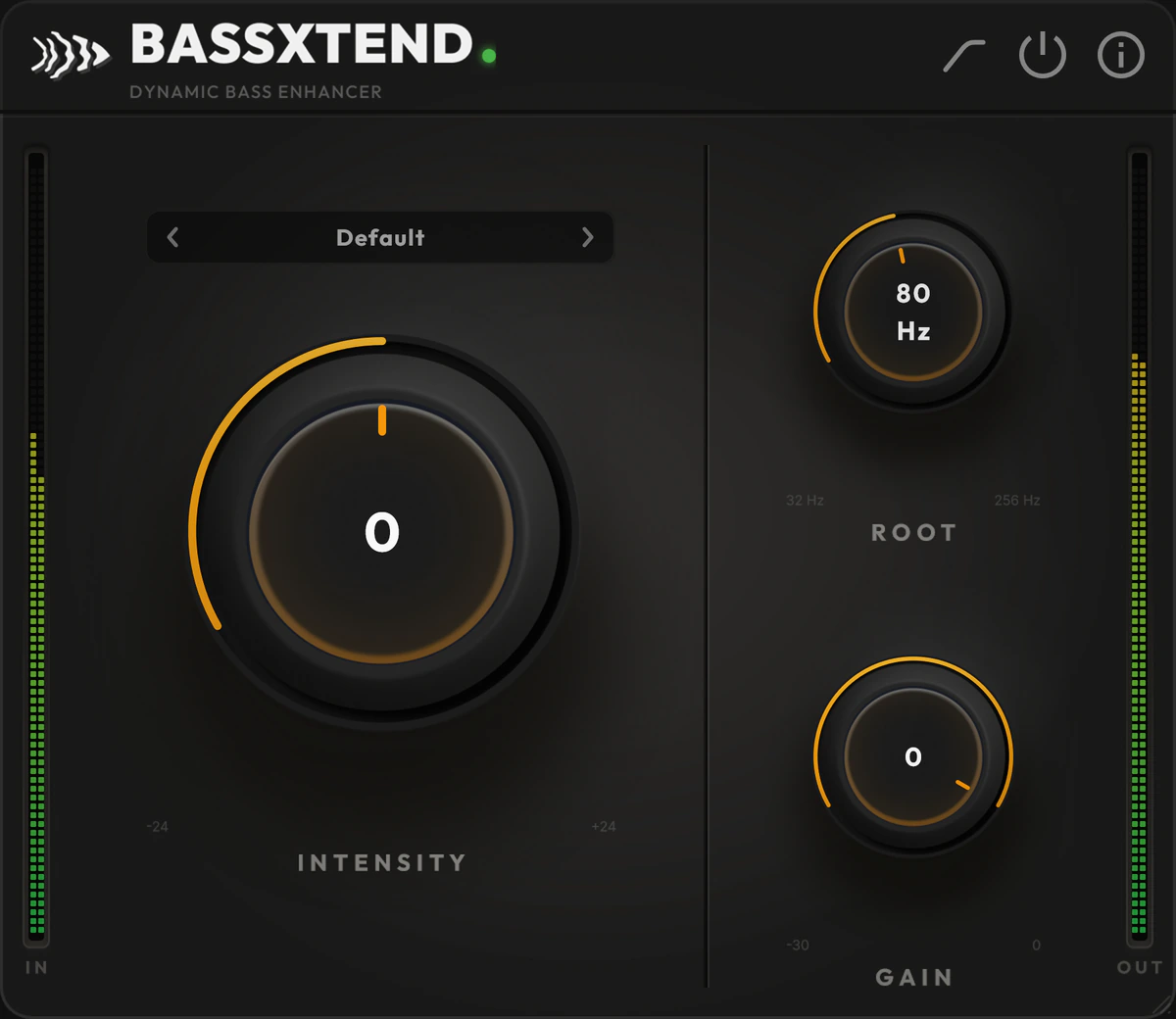
The workflow is short. Set Root (32 to 256 Hz) around the region you want to translate. Raise Intensity (-24 to +24 dB) during the limited playback check until the bassline stays identifiable. Use Gain to compare fairly against bypass. To hear exactly what's being added, switch Low Band to Out for a moment: the original bass drops away and only the generated harmonics remain.
BassXtend is €19.99 as a one-time purchase, in VST3 and AAX on Windows and VST3, AU and AAX on macOS. It runs with zero latency. There is a free 7-day trial.
FAQ
Bass translation questions, answered
Why can't I hear my 808 on phone speakers?
Phone speakers reproduce very little of the region where an 808's fundamental sits, and many 808s put nearly all their energy there. With little harmonic content above it to carry the note, it shrinks to a click or disappears. Adding information higher in the spectrum usually helps far more than boosting the sub.
Should I boost bass with EQ or add saturation?
It depends on the source. EQ changes frequencies that are already there, so it suits a bass that already has harmonics and body, as most bass guitars do. Saturation creates new harmonics, which helps a near-sine source where EQ has little to work with, but it also changes the tone. Compare both at matched levels.
What is the missing fundamental?
It's an effect of pitch perception. Hear harmonically related frequencies such as 100, 150, 200 and 250 Hz, and you tend to perceive a pitch at their common spacing, 50 Hz, even when little energy is present at 50 Hz. You hear the low note's pitch without its physical weight.
Are subharmonics the same as bass enhancement?
No. A subharmonic generator creates content below the source, often an octave down, adding physical depth on systems that can play it. Psychoacoustic bass enhancement generates harmonics above the deep bass so low notes stay perceptible on systems that can't reproduce them.
Should I put a bass enhancer on the master?
It can work subtly, but individual tracks give better control. On a master the processor reacts to the kick, the bass and every other low element at once. Start conservatively and level-match against bypass.
How do I make bass louder without losing headroom?
Aim for perceived bass rather than more deep low-frequency energy. Harmonic information above the sub is easier to hear and usually costs far less headroom than a boost at 40 or 50 Hz. Keep the low-end arrangement uncluttered, and level-match every change so you're judging the bass, not the volume.